Grid canvas for Elementor: a configurable line grid drawn behind any section, for technical and editorial backdrops.
Three hundred and forty parts, finished by six people in a workshop above a bakery in Bienne. No sub-brands, no anniversary editions, and a waiting list we publish in full.
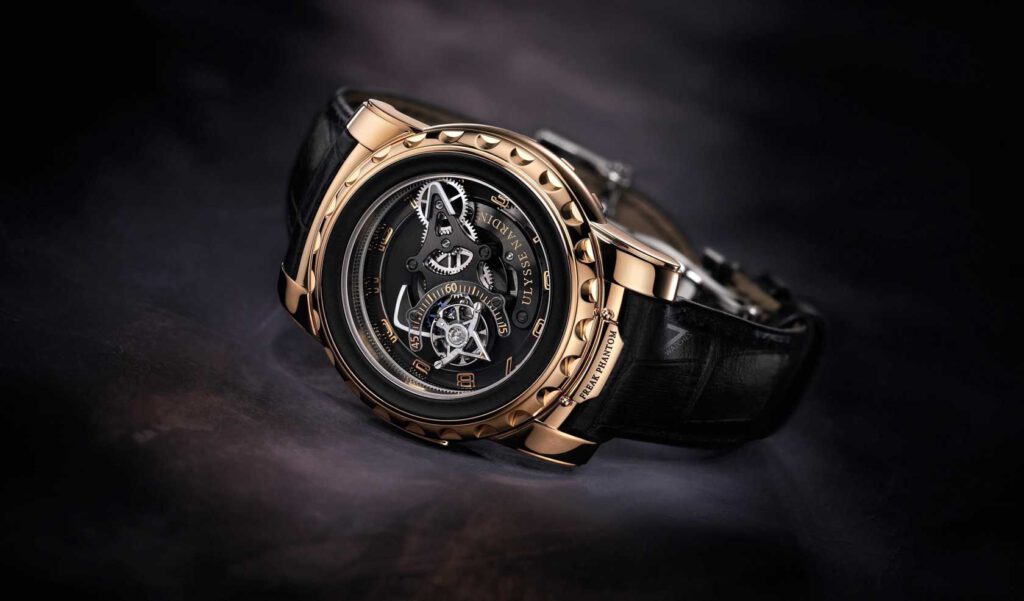

Every Ostrand ships with an exhibition back because a movement you cannot inspect is a movement you are taking on faith. The bridges are hand-bevelled, the screws are blued in a kiln we built ourselves, and none of it is hidden behind a solid caseback with a logo on it.
Everything below is measured on your specific watch and printed on the certificate that travels with it. If a number drifts in the first two years we correct it for nothing.
Counted, not estimated. Nineteen of them exist only in this movement.
From one barrel. We would rather it ran long than ran twice.
Regulated in six positions over fourteen days before it leaves.
All six sign the certificate. You can write to any of them.
We could halve the build time by machine-finishing the bridges and nobody would see the difference through a loupe held at arm’s length. We have tried it. It is not the same watch.
Every part is drawn at 20:1 on paper before anything is cut. The drawings ship with the watch.
Plates and bridges from German nickel silver, hardened, then left three weeks to settle.
Bevels, black polish and perlage. This is the slow part: eleven days per movement.
Six positions, fourteen days, three temperatures. Then it is taken apart and done again.
“I asked whether the escape wheel could be replaced in twenty years and got a two-page letter back from the man who cuts them. That answered a different question than the one I asked, which is why I bought it.”

Ostrand has serviced every watch it has ever sold, including the fourteen from 1996 that we would rather forget the dial on. Parts for every calibre are cut in-house and held indefinitely.
There is no configurator. There are three references, a waiting list we publish, and a deposit you can get back at any point before the watch is cased.
Prices include VAT and shipping in the EU and UK.
Deposit refundable in full up to delivery.
Prices include VAT and shipping in the EU and UK.
Put your name down and you get a position number, an estimated quarter, and an email whenever either changes. Nothing is charged until we cut your plate.
Straight answers about what this one does, where it fits in a real build, and what it costs you to ship.
Read the documentation for this one, or write to us — a human answers inside a business day.
Two places, neither of them a widget. Sky Addons for Elementor adds a Grid Canvas section to the Style tab of any section or container, and the same set of controls to Page Settings so one grid can run behind an entire page. Header and footer templates are deliberately excluded.
All three. Line Type offers Vertical, Horizontal and Both, and the density is yours: Columns and Rows each run from 2 to 24, defaulting to 12 columns and 8 rows. Line Width goes from 1 to 10 pixels, so the grid can read as a hairline blueprint or as heavy rules.
Yes. Columns, Rows, Line Width and Max Width are all responsive controls, so a 12-column desktop grid can drop to 4 on a phone where the lines would otherwise crowd together. Set the desktop value first, then switch breakpoints and override only what needs to change.
Turn on Gradient Mask. Direction picks which way it fades — top to bottom, bottom to top, left to right or right to left — and two sliders set the stops: Visible Until, where the grid is still at full strength, and Hidden From, where it has gone completely. Both are percentages.
Yes. Animation Mode offers Fade In and Draw In, both tied to scrolling, plus a looping Pulse with its own speed from 0.3 to 10 seconds. Where the browser supports scroll-linked CSS animation the reveal tracks the scroll position; elsewhere it simply plays once when the element loads.
None at all. The whole effect is one out-of-flow layer plus CSS custom properties, and even the animations are keyframes rather than script. Nothing is drawn on a canvas element or generated at runtime, so it costs no main-thread work however many sections use it.
No, not by default. Z-Index starts at -1, which puts the lines behind the content and behind an Elementor Background Overlay, and the layer ignores pointer events entirely. Raise Z-Index anywhere from 0 to 99 when you deliberately want the grid drawn over an overlay or an image.
Yes, that is what Exclude Selectors is for. List comma-separated CSS selectors in Page Settings and the grid is painted over inside those elements using the Escape Background colour, which defaults to white — set it to your page background so the grid disappears cleanly. The exclusion applies on the front end, not in the editor preview.
Because the default line colour is white at 12 percent opacity, chosen for dark sections. On a light background set Line Start Color to something dark and low-opacity. Adding a Line End Color blends the lines from one colour to the other across the grid, and doing so takes over from the Column Fill tint.
No. It ships in the free Sky Addons plugin and needs only free Elementor. Six blend modes — normal, multiply, screen, overlay, lighten and colour dodge — plus an opacity slider let the lines sit over photography without a second overlay element or any custom CSS.
Elementor widgets and extensions by wowDevs — built for people who would rather ship than fight a page builder.
One short email when something ships. No drip sequence.